
Tafelmusik Baroque Orchestra
Directed by Rachel Podger
Performances:
January 29–February 1, 2026 at Jeanne Lamon Hall, Trinity-St. Paul’s Centre
Program
Johann Sebastian Bach
1685–1750
Brandenburg Concerto no. 1 in F Major
Allegro – Adagio – Allegro – Menuet/Trio/Polonaise/Trio
Rachel Podger, piccolo violin
Daniel Ramírez Escudero, Marco Cera & Kathryn Montoya, oboe
Dominic Teresi, bassoon
Todd Williams & Micajah Sturgess, horn
Prelude and Fugue in F Major, after BWV 552
INTERMISSION
Brandenburg Concerto no. 2 in F Major
Allegro – Andante – Allegro assai
Kathryn Montoya, recorder
Daniel Ramírez Escudero, oboe
Todd Williams, horn
Julia Wedman, violin
Brandenburg Concerto no. 3 in G Major
Allegro – Adagio [ad libitum] – Allegro
Rachel Podger, Johanna Novom & Geneviève Gilardeau, violin
Brandon Chui, Patrick G. Jordan & Christopher Verrette, viola
Keiran Campbell, Michael Unterman & Margaret Gay, violoncello
Brandenburg Concerto no. 4 in G Major
Allegro – Andante – Presto
Kathryn Montoya & Dominic Teresi, recorder
Rachel Podger, violin
Program Notes
By Charlotte Nediger
Bach held the post of Music Director at the court of Anhalt-Köthen from 1717 to 1723. This was the only one of Bach’s jobs that required him to devote himself almost exclusively to the composition and performance of instrumental music. He took this opportunity to organize some of his instrumental output into sets, including the first volume of The Well-Tempered Clavier, the French and English suites for harpsichord, the sonatas for violin and harpsichord, and the suites for solo cello and for solo violin. Each collection is proof of Bach’s ability to achieve the maximum variety within each genre. Nowhere is this more evident than in the collection of concertos assembled by Bach in 1721. The meticulous autograph score of “Six concerts avec plusieurs instruments“ [“with several instruments”] was dedicated to the Margrave of Brandenburg. He kept his own ensemble of musicians at Schloss Charlottenburg in Berlin and amassed a collection of scores of concertos “by diverse masters,” most of them Italian. Bach notes in the dedication that the set was presented in somewhat belated response to a request that the Margrave had made some two years earlier to see “some pieces of my Composition.” However, the Margrave’s fair copy of the score—the only complete copy of the six concertos—seemingly lay untouched on his library shelves. We have no evidence that he ever heard the works. Little did he know what he was missing—nor that his renown centuries later rests almost entirely on his name appearing in their titles.
Bach’s own title of concertos “avec plusieurs instruments” was apt, as the variety of instrumentation in these concertos is their trademark feature and far exceeds that of any comparable set from the period. The choice of instruments was probably inspired by the musicians of the Cöthen court. The sixteen regular members of the Capelle included almost all the instrumentalists needed to perform the six works.
The First Concerto is the largest, scored for a generous ensemble of three oboes, bassoon, two horns, a solo violin, and strings. The solo violin part is to be played on a violino piccolo, a small instrument tuned a third higher than the usual violin. Its bright tone contrasts wonderfully with the robust sound of the horns and the rich timbre of the quartet of double-reed instruments. Much of the concerto is a reworking of a sinfonia that introduced the secular cantata “Was mir behagt, ist nur die muntre Jagd,” BWV 208, written in 1713 for the hunting festivities celebrating the birthday of Prince Christian of Saxe-Weissenfels—hence the inclusion of horns, who announce their presence in the first movement with traditional hunting calls.
The solo group of the Second Concerto is the most disparate: Bach asks for trumpet, recorder, oboe, and violin. Particularly noteworthy is the uncommonly brilliant trumpet part written for a trumpet in F. Bach’s trumpet parts are often demanding, but are written for trumpets in C and D. Bach obviously had a trumpet player capable of playing the very high solo passages that result from playing on the higher-pitched F trumpet. Already by the middle of the 18th century such players were rarities. A copy of the score by Bach’s pupil C.F. Penzel made around 1760 suggests substituting a horn and transposing the part down an octave. It is still very challenging, but brilliant horn players were a little more plentiful. A later copy suggests a flute, and 20th-century performances have substituted various instruments, among them clarinet, piccolo-heckelphone, and sopranino saxophone! This week we follow Penzel’s suggestion of having a horn play the extraordinary solo part: the warmer sound of the horn imbues the sound of the solo quartet, offering a different experience of the concerto.
The Third Concerto was clearly inspired by Vivaldi’s L’Estro armónico, a collection of concertos for one, two, or four violins, several of which Bach had transcribed (brilliantly!) for keyboard. As in the Vivaldi model, Bach creates an orchestra out of a group of solo string players, but takes the concept a step further: his concerto is scored not only for three solo violins, but also three violas and three cellos, all supported by double bass and harpsichord continuo. He constantly shifts the roles of the nine solo players: at times the three groups engage in playful dialogue; at other times an individual steps forward for a brief solo; and at yet other times all eleven instruments come together to play an “orchestral” tutti. Bach composed only the two outer movements, linking them with two chords marked Adagio, leaving one or more of the players to improvise as they see fit.
The Fourth Concerto features a trio of solo instruments: a solo violin is paired with two recorders, the violinist taking the lead in brilliant passagework. The violin yields to the recorders only in the slow movement, playing an accompanying role to their plaintive echos (Bach lists them as “flauti d’echo” in the score). The essential character of all six concertos is one of joyful celebration. and nowhere is this more evident than in the exuberance of the solo violin part in the final movement. This is virtuosity at its most delightful, not there to impress (though it is very impressive!), but to invite performers and audience alike to set care aside and join the party. Bach’s creative exploration of the sound worlds created by the various combinations of instruments in the Brandenburg Concertos is the inspiration for a new transcription created by bassoonist and Artistic Co-Director Dominic Teresi: an arrangement for orchestra of Bach’s organ Prelude and Fugue in E-flat Major. The two parts of this monumental work frame the third volume of Bach’s Clavier Übung (Keyboard Practice), a series of four books of keyboard music self-published by Bach as a testament to his keyboard writing. The third book is the only one devoted to the organ (the other three contain harpsichord works). It offers music in a wide range of styles, both ancient and modern, and is a virtual textbook of contrapuntal techniques. The opening Prelude is a grand French overture in three parts: the opening and closing sections are joyful and buoyant, and the middle section incorporates elements of a galant Italianate concerto and German fugal writing. In essence, it is an orchestral work imagined by Bach for the organ. On hearing a colleague play the work on baroque organ with its range of colours, Dominic imagined how it might sound played on the instruments of the core Tafelmusik Orchestra: two oboes, bassoon, strings, and continuo. The result is the transcription you are hearing this week, and the Prelude could be a stand-alone work. And yet it finds it raison d’être in its corresponding Fugue, printed at the end of the volume, and so our transcription continues. We are now presented with a complex double fugue with three subjects. Connoisseurs of counterpoint can revel in its structure, but in Bach’s hands, knowledge of the science is not required to appreciate the art. To hear it is to be elevated to a realm of wonder.
For tickets, visit: tafelmusik.org/brandenburgs
Tafelmusik Baroque Orchestra
Violin 1
Rachel Podger, Patricia Ahern, Geneviève Gilardeau, Julia Wedman
Violin 2
Cristina Zacharias, Johanna Novom, Christopher Verrette
Viola
Patrick G. Jordan, Brandon Chui, Christopher Verrette
Violoncello
Keiran Campbell, Michael Unterman, Margaret Gay
Double Bass
Nathaniel Chase
Recorder
Kathryn Montoya, Dominic Teresi
Oboe
Daniel Ramírez Escudero, Marco Cera, Kathryn Montoya
Bassoon
Dominic Teresi
Horn
Todd Williams, Micajah Sturgess
Harpsichord
Charlotte Nediger
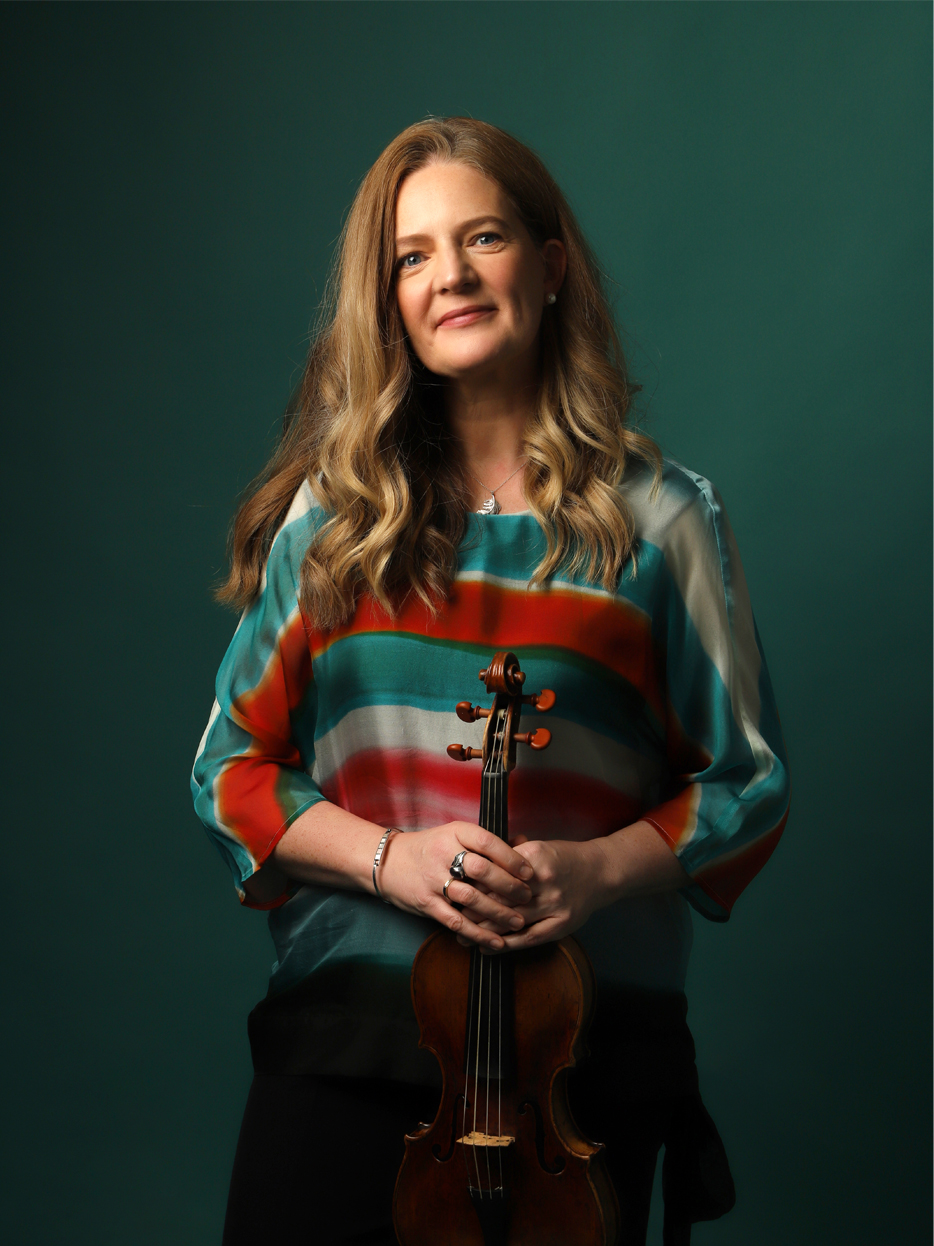
Rachel Podger
Principal Guest Director
Rachel Podger, “the unsurpassed British glory of the baroque violin” (The Times), has established herself as a leading interpreter of baroque and classical music. She was the first woman to be awarded the prestigious Royal Academy of Music/Kohn Foundation Bach Prize in October 2015, Gramophone Artist of the Year 2018, and the Ambassador for REMA’s Early Music Day 2020. A creative programmer, she is the founder and Artistic Director of Brecon Baroque Festival and her ensemble Brecon Baroque, is Patron of The Continuo Foundation, and an Ambassador for the Learned Society of Wales.
Rachel was awarded BBC Music Magazine Recording of the Year and Instrumental Award for her solo albumTutta sola. Recent releases include The Muses Restor’d with Brecon Baroque, The Best of Biber 1681 Sonatas, and Haydn Symphonies 43 & 49 with Tafelmusik, described as “sensational” (Early Music America). A dedicated educator, she holds the Micaela Comberti Chair for Baroque Violin at the Royal Academy of Music, and the Jane Hodge Foundation International Chair in Baroque Violin at the Royal Welsh College of Music and Drama. Rachel also has a regular relationship with The Juilliard School in New York.
Rachel Podger took up the position of Principal Guest Director of Tafelmusik Baroque Orchestra in September 2024.
Piccolo Violin
Bach’s Brandenburg Concerto no. 1 features a piccolo violin—smaller and tuned a third higher than a usual violin, its bright tone is a wonderful contrast to the robust horns and rich oboes.
We are very grateful to the renowned international violin dealer Beare Violins Ltd. for very generously loaning Rachel Podger a piccolo violin to play at this week’s concerts. The instrument was made by Jacob Stainer of Absam, Austria in 1659, and has been in the Beare collection for several decades. We are thrilled to be able to offer this rare opportunity to hear this special instrument.