Directed by Rachel Podger
Performances:
April 9, 2026 at George Weston Recital Hall
April 10–12, 2026 at Jeanne Lamon Hall, Trinity-St. Paul’s Centre
Program
Johann Christian Bach
1735–1782
Sinfonia in G Minor, op. 6, no. 6
Allegro – Andante più tosto adagio – Allegro molto
Wolfgang Amadeus Mozart
1756–1791
Violin Concerto no. 3 in G Major, KV 216
Allegro – Adagio – Rondeau: Allegro
Rachel Podger, violin soloist
INTERMISSION
Carl Philipp Emmanuel Bach
1714–1788
Cello Concerto in A Major, Wq.172
Allegro – Largo – Allegro assai
Keiran Campbell, cello soloist
Joseph Haydn
1732–1809
Symphony no. 52 in C Minor
Allegro assai con brio – Andante – Menuetto & Trio – Finale: Presto
Program Notes
By Michael Unterman
We’ve all been the butt of that humbling shorthand of being known, not as our individual selves, but as “someone else’s someone”—their child, sibling, parent, partner, or friend. It’s only natural to think of people in this way: whoever happens to be closest to us becomes the centre of a web of relationships. Curiously and confusingly though, we do the same thing with historical figures, but now with surnames: Leopold is “Mozart’s father” and, alas, Carl Philipp Emanuel and Johann Christian are invariably “Bach’s sons.”
It’s hardly worth the trouble of avoiding this, but it is worth checking ourselves from time to time, lest “Bach’s sons” become perpetual youths in our mind’s eye instead of the influential mentors, trailblazers, and father figures they were. Indeed, during Emanuel and Christian’s adult lives, Johann Sebastian would have been “Bach’s father” for most in relation to his (then) far more famous sons.
For the sake of placing our four protagonists, the day Wolfgang Amadeus Mozart was born —January 27, 1756—Emanuel Bach would have been 41 years old, Haydn 23, and Christian Bach 20; but as we’ll see, despite the generational gaps between them, there is no inkling of an upstart vs. establishment rivalry, only admiration, support, and game-recognize-game appreciation.
Christian and Mozart’s connection was an important and enduring one, and it’s not hard to see why: both the youngest sons of imposing fathers, the black sheep of their families (read: troublemakers), and precocious young talents at the keyboard. They would also forge similar paths in eschewing the stability of court and church patronage for the freedom of entrepreneurship and the glamour of the opera world.
In this, Johann Christian Bach stands out as by far the most adventuresome of any of his immediate family: losing his father at age 14, running off to Italy at 19 (allegedly in the company of a young soprano), converting to Catholicism at 25, and receiving a commission to write operas (of all things!) for the King’s Theatre in London at age 27. He travels to London to oversee their production and stays, the city remaining his home henceforth. In addition to his composing, he also becomes an important impresario, establishing the Bach-Abel Concerts with fellow German emigree Carl Friedrich Abel, a subscription concert series that would become an influential showcase for the latest instrumental and vocal works.
Enter Mozart, age eight, visiting London as part of a grand concert tour with [pause for effect] his father. Naturally the German-speaking visitors meet the expats, and Christian and “Wolfie” become fast friends. They play duets together and Christian sends the young prodigy off with a farewell gift, the autographed manuscript of one of his keyboard sonatas. Their meeting leaves a lasting impression on Mozart and their paths happily cross once more in Paris, 14 years later, a much-needed balm shortly following the death of Mozart’s mother.
Aptly then, these two bosom buddies share the first half of our program, their cavalier swagger and opera chops on full display, Christian bringing a tragic opera seria mood and Wolfgang the comedic opera buffa.
Christian’s Sinfonia in G Minor, op. 6, no. 6 is particularly striking in its commitment to going all in, all three movements in the darkly minor keys of G and C. Far from a gloom-fest, however, nobility, elegance, and heroic defiance all bring balance to the mix—that is, until the symphony exits on an unsettling note, quietly slipping out the door.
Mozart’s iconic Violin Concerto no. 3, by contrast, is a barrel of laughs: irreverent, unpredictable, joyful. It is a snapshot of the 19-year-old, chomping at the bit to break free of the stifling Salzburg court. The first movement is full of mischief: a sudden expectant pause interrupts the very first phrase only to burst out like a jack-in-the-box; the solo violin a comedian full of sly winks and asides. The second movement is every bit as contented, but here opts to float rather than dart and dash. The third, disguising itself as an ordinary rondo, suddenly hits shuffle in Mozart’s brain halfway through, throwing a smoky gavotte and a jaunty Alsatian folk tune into the pot before skipping the record back into its groove. Here, like Christian’s Sinfonia, Mozart also opts to ghost the audience, the winds passing along the soloist’s regards.
Our second half pairs two composers who shared a deep mutual respect, especially from Haydn towards the elder Emanuel. Indeed Haydn, who reportedly styled himself a true original and is said to have bristled at the suggestion of any composerly influence, made his one-and-only exception for Emanuel Bach. “I did not leave my keyboard until I had played them all through,” he said of an opus of sonatas, “and whoever knows me thoroughly must discover that I owe a great deal to Emanuel Bach, that I understood him and studied him with diligence. [He] once paid me a compliment on that himself,” a tribute one hopes Emanuel gave with a humble wink.
This twosome bring a more down-to-earth energy to the program—instead of madcap, the humor is witty; and instead of lightness, there is a sense of earnestness—but all the works on this program most definitely share big feelings, a strong rebuttal to the idea of “classical restraint.” If Christian’s symphony is an encapsulation of fire and smoke, then Haydn’s is a Shakespearean tragedy; and if Mozart’s Concerto depicts a mind at its sharpest and most ebullient, then Emanuel’s concerto depicts its most heartfelt joys and sorrows.
The first movement of the Cello Concerto in A Major is a masterclass in just how organic a classical form can be. The banter between the cello and orchestra is free flowing, engaging, and joyful, playfully crossing structural lines and mix-matching who plays what, and when the orchestra adds a ripple of doubt to the mix, the soloist turns into the chop and seamlessly rights the ship. The second movement is the mirror image of the first: a sit-down with one’s sorrows, the occasional ray of sunlight providing the strength to forge on. And the third is back to pure joy, culminating in an epic ramble for the solo cello: a torrent of triplets that morphs like a kaleidoscope through keys and colours.
We finish with Haydn’s Symphony no. 52 in C Minor, one of his so-called Sturm und Drang symphonies: a mislabelling in a sense, as the phrase had yet to be coined. One of the theories that might explain this relatively brief outburst of stormy and anxious symphonies are the many theatrical productions being produced at this time at the Esterházy court, where Haydn was employed. These mostly included comedies, but also notably Shakespearean tragedies, including Hamlet and King Lear for which Haydn may have written overtures and entr’actes that became the outer movements of his symphonies.
There is no hard evidence for this, but we might point out that this symphony opens with moods of danger, ghostly echoes, heroic defiance, jump-scare surprises, and introverted musings; and if you told me this was the overture to Hamlet, well …
The next three movements are a crescendo of tension. The second movement is placid on its surface, but shows cracks as it progresses. The Menuet is a step up, back to dark C minor and accented oddly, with its companion trio providing a contrast that is perhaps too cheery … a forced smile. The Presto finale plays with tension and release, keeping the lid on until it simply cannot hold any longer.
For tickets, visit: tafelmusik.org/influencers
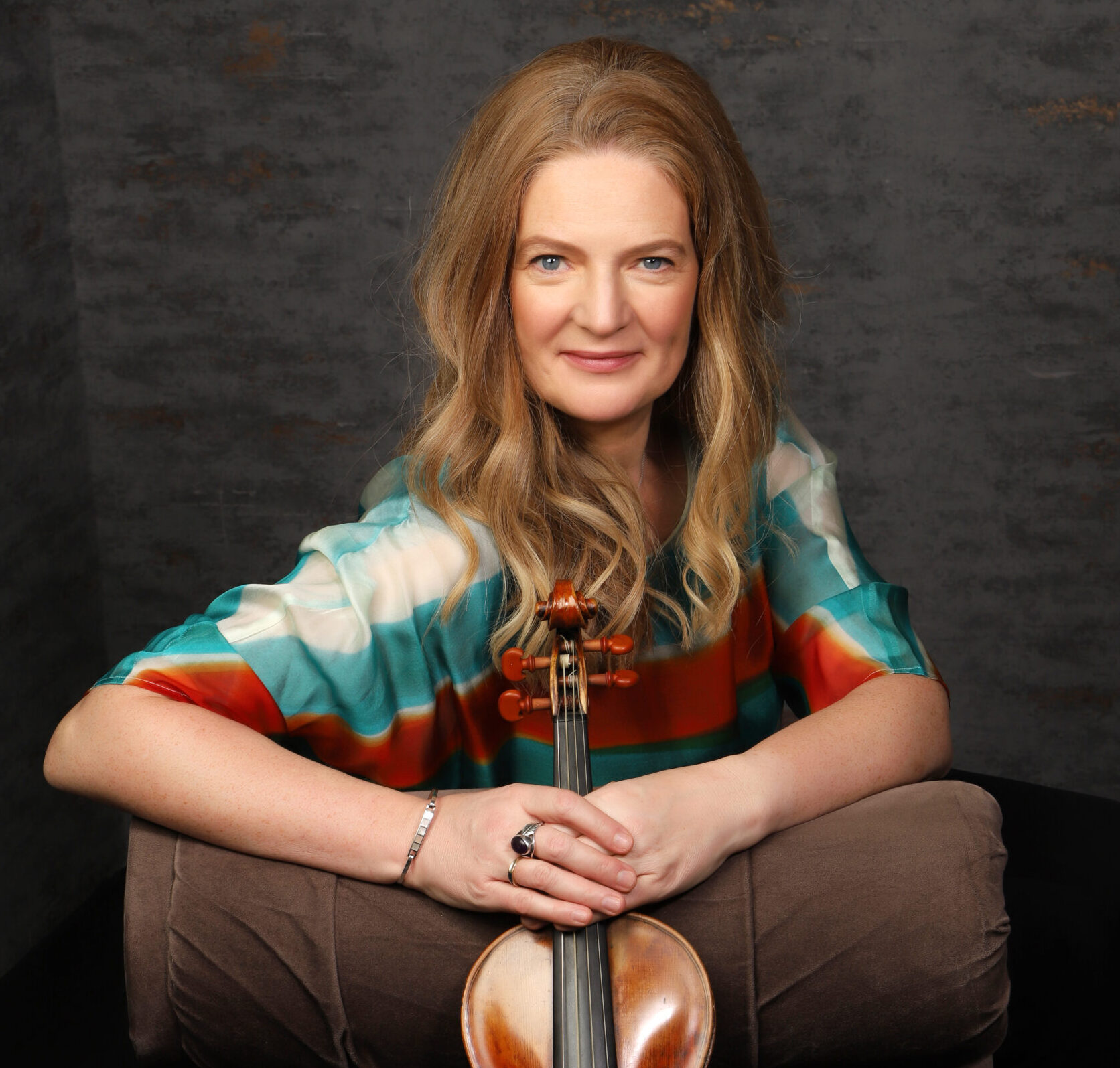
Rachel Podger
Principal Guest Director & violin soloist
Rachel Podger, “the unsurpassed British glory of the baroque violin” (The Times), has established herself as a leading interpreter of baroque and classical music. She was the first woman to be awarded the prestigious Royal Academy of Music/Kohn Foundation Bach Prize in October 2015, Gramophone Artist of the Year 2018, and the Ambassador for REMA’s Early Music Day 2020. A creative programmer, she is the founder and Artistic Director of Brecon Baroque Festival and her ensemble Brecon Baroque, is Patron of The Continuo Foundation, and an Ambassador for the Learned Society of Wales.
Rachel was awarded BBC Music Magazine Recording of the Year and Instrumental Award for her solo albumTutta sola. Recent releases include The Muses Restor’d with Brecon Baroque, The Best of Biber 1681 Sonatas, and Haydn Symphonies 43 & 49 with Tafelmusik, described as “sensational” (Early Music America). A dedicated educator, she holds the Micaela Comberti Chair for Baroque Violin at the Royal Academy of Music, and the Jane Hodge Foundation International Chair in Baroque Violin at the Royal Welsh College of Music and Drama. Rachel also has a regular relationship with The Juilliard School in New York.
Rachel Podger took up the position of Principal Guest Director of Tafelmusik Baroque Orchestra in September 2024.
Season Presenting Sponsor

Season Partners

Government Sponsors